
Bioprocessing has evolved dramatically over the past decade. Higher-expressing cell lines, intensified upstream processes, and more complex purification workflows mean you’re routinely handling higher protein titers and more valuable intermediates than ever before. But while processes have advanced, one area frequently lags behind: UV absorbance measurement, typically performed with UV-VIS photometers.
Inline UV monitoring provides absorbance data used in chromatography, tangential flow filtration (TFF), and other downstream steps. Yet the optical design of traditional analyzers was never built for today’s concentration ranges, process speeds, or quality expectations. As a result, many bioprocess teams encounter a quiet but costly problem: their UV measurements are no longer accurate enough for modern workflows.
Poor UV data affects everything from peak purity to yield to regulatory documentation. And because these issues often appear gradually — through flatter peaks, drift, or inconsistent end points — teams sometimes don’t realize how much performance they’re losing until it shows up in batch results.
Before looking at solutions, it helps to understand why this measurement gap exists.
Key Takeaways
- High-titer processes amplify optical limitations in traditional UV analyzers, including stray light, non-linearity, and clipped peaks.
- Chromatography and filtration workflows depend on crisp, real-time UV signals to optimize yield, purity, and process control.
- Modern analyzers must offer deep-UV capability, zero-dead-volume cells, stable long-life light sources, and traceable verification to keep pace with today’s bioprocessing demands.
The Problem: Higher Protein Levels Expose Optical Weaknesses
Protein titers have risen steadily as upstream processes become more efficient. But higher concentrations lead directly to higher absorbance values — and this is where conventional UV systems start to struggle.
Most legacy analyzers suffer from a fundamental issue: they fail to adequately block stray light entering the measurement path.
Stray light reduces apparent absorbance, producing:
- artificially low readings at high concentrations
- distorted peak shapes
- non-linear response curves
When measuring very concentrated proteins or API intermediates, these distortions become magnified. In practice, this means:
- A peak that should rise sharply instead appears broadened.
- True concentration levels get underestimated.
- Fraction cut points become harder to determine reliably.
Higher protein levels also increase the likelihood of peak clipping, where the analyzer simply cannot track the full height of the absorbance signal. Once clipped, the top portion of the peak is lost — making the data unusable for accurate purity or yield calculations.
With intensified processing and higher-value product streams, this is no longer acceptable.
Dead Volume Creates Dilution — and Costly Errors
Optics aren’t the only problem. Many older UV analyzers use flow cells with internal hold-up volume, which mixes fresh product with fluid already inside the cell.
The effect is dilution — and dilution blurs everything:
- Chromatography peaks appear less sharp
- Peak onset and decline are harder to detect
- Cut points shift
- Purity suffers
- Yield declines
Zero hold-up volume preserves crisp peak profiles, while even small pockets of trapped liquid can erode purity. This problem only becomes more costly as concentration increases and margins tighten.
Where the Measurement Gap Shows Up Most
1. Chromatography
Chromatography depends on real-time UV signals to identify when protein, API, or intermediates elute from the column. When absorbance is unreliable:
- Peak maxima may be flattened
- Shoulders and tails may blur
- You may divert too early or too late
- Collected fractions become less pure
Higher titers and smaller column volumes make separation faster — which means the UV analyzer must respond with both speed and accuracy.
2. Tangential Flow Filtration (TFF)
TFF is another workflow where measurement weakness quickly becomes a process problem. Real-time absorbance data at feed, retentate, and permeate points supports stable filtration performance and early loss detection.
Accurate UV data determines:
- feed control
- retention balance
- filtrate breakthrough detection
- concentration end points
When analyzers clip peaks or drift, operators lose visibility into filtration efficiency. Breakthrough events — which signal product loss — may be detected too late. And if feed concentration is misread, you risk suboptimal flux, fouling, or yield loss.
3. Process Purity and End-Point Decisions
From early upstream monitoring of expression to final polishing, UV absorbance informs decisions such as:
- when to collect
- when to stop
- when to transition
- whether the purity meets spec
- whether a deviation is real or instrument-driven
Any measurement drift, noise, or non-linearity cascades into downstream effects. When batches are large and intermediates are valuable, even small UV errors translate directly into rework, yield loss, or quality risk.
What a Modern UV Analyzer Must Deliver
With these challenges in mind, today’s bioprocess UV analyzer must offer more than a basic absorbance reading. Essential requirements include:
1. Deep UV capability (down to 190 nm)
Essential for measuring proteins, peptides, nucleic acids, and small molecules with accuracy.
2. Multi-wavelength analysis
Not just one wavelength — but multiple, simultaneously — to detect APIs, monitor purity, and quantify intermediates.
3. True zero-dead-volume hygienic cells
Critical for sharp chromatography peaks and contamination-free processing.
4. High linear range without clipping
Modern workflows demand linearity at absorbance levels far above traditional equipment capabilities.
5. Stable, long-life light source
The value of mercury-free xenon light sources with long lifespan and minimal drift is well documented.
6. Fast sampling and real-time response
Chromatography and TFF move quickly; UV measurement must keep up.
7. Traceable, integrated verification
NIST-compliant reference standards and built-in verification ports simplify documentation and compliance.
Closing the Gap: The Kemtrak UV Spectra Process Analyzer
Engineered for Deep-UV Bioprocess Measurement
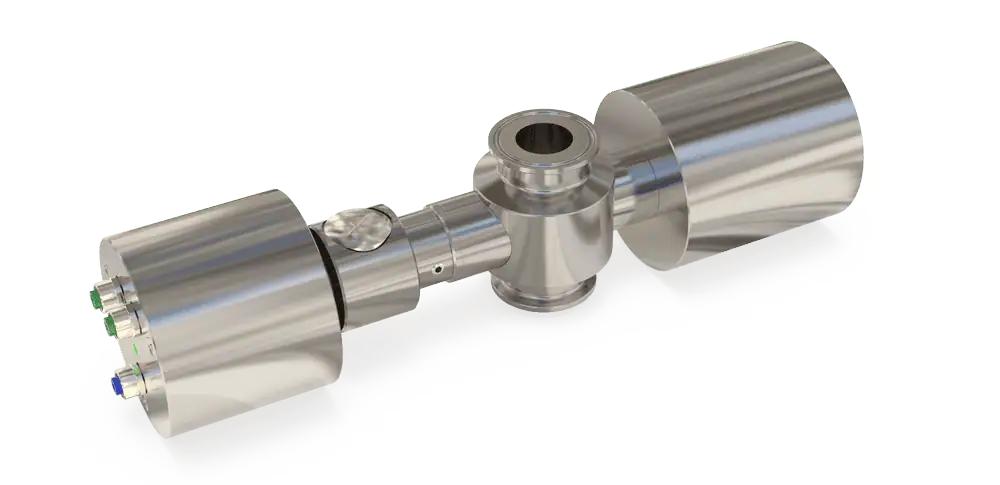
The Kemtrak UV Spectra Process Analyzer, distributed by South Fork Instruments, is specifically designed to address the measurement limitations that legacy UV systems cannot overcome.
It delivers multi-wavelength deep-UV detection from 190–440 nm, enabling precise measurement of proteins, peptides, nucleic acids, and critical intermediates across a broad concentration range.
Zero-Dead-Volume Cells Protect Peak Quality
Kemtrak’s zero-dead-volume hygienic measurement cells eliminate internal dilution and preserve peak shape during chromatography. This helps maintain:
- sharper, more defined peaks
- accurate cut points
- higher purity and yield
High-Resolution Optics Prevent Clipping and Distortion
The analyzer’s optical design minimizes stray light and maintains linearity even at elevated absorbance levels. As a result:
- peak clipping is avoided
- high-titer measurements stay accurate
- both large and subtle concentration changes remain visible
Real-Time Performance for Chromatography and TFF
With rapid, high-resolution sampling and multi-wavelength detection, the UV Spectra supports real-time decisions in:
- chromatography fraction collection
- TFF feed and retentate control
- breakthrough and loss detection
- intermediate quantification
Long-Life, Mercury-Free Light Source
A deep-UV xenon light source delivers up to two years of continuous operation with minimal drift — while remaining mercury-free and RoHS compliant.
Integrated Verification for Regulated Environments
The UV Spectra includes:
- NIST-traceable reference standards
- an integrated verification port
- documentation aligned with regulatory expectations
These features support reliable performance checks without removing the analyzer from the process line.
A More Reliable Way Forward
As protein titers rise and process intensification becomes the norm, UV measurement must evolve as well. The gap between what legacy analyzers deliver and what modern workflows require is widening — and many teams don’t realize how much performance they’re losing until they see the difference.
Whether in chromatography, TFF, API purification, or intermediate monitoring, inline UV data drives decisions that impact yield, quality, and operational efficiency. A modern analyzer closes that gap with optical precision, stability, real-time multi-wavelength capability, and traceable verification built for today’s bioprocessing environment.
For teams navigating increasingly complex workflows, eliminating UV measurement limitations is one of the most effective ways to protect product, improve purity, and increase confidence in every batch.
Speak With South Fork Instruments
Better UV measurement starts with choosing the right analyzer and the right configuration for your specific process. South Fork Instruments can help you evaluate wavelength, pathlength, and cell design options to ensure your chromatography, filtration, or inline monitoring system performs the way you need it to.
To discuss your application or request technical guidance, contact South Fork Instruments at (925) 461-5059 or fill out this form on our website.
Frequently Asked Questions
Read More