
- Home
-
- Coriolis Mass Flow Meters
- High Pressure Coriolis Flow Meters
- Turbidity Measurement Solutions
- Color Measurement Solutions
- UV-VIS-NIR Concentration Measurement
- Solids Concentration Measurement
- Oil-in-Water Measurement
- NIR Optical Probes & Process Sensors
- pH & ORP Electrodes
- Water Quality Analyzers
- Process Sensors
- Sensor Housing & Holder Solutions
- Foam Detection & Control
- Spectroscopic Compositions Analysis
- Moisture Analysis
- Oil-On-Water
- Algal Bloom
-
- Rheonik Mass Flow Meters
- Exner NIR Process Sensors
- Exner Housings & Accessories
- Kemtrak Photometers
- Kemtrak Turbidimeters
- Kemtrak Oil-in-Water Analyzers
- UV Absorbance Photometers
- Hycontrol Foam Detection & Control
- Refex pH & ORP Electrodes
- SPX Flow Water Quality Analyzers
- SFI pH/ORP Sensor
- pH/ORP Transmitters
- Inline Spectrophotometers
- Portable Spectrophotometers
- Oil-On-Water ROW
- Algal Bloom Row
- Contact
- Call 866-953-4668
- Home
-
- Coriolis Mass Flow Meters
- High Pressure Coriolis Flow Meters
- Turbidity Measurement Solutions
- Color Measurement Solutions
- UV-VIS-NIR Concentration Measurement
- Solids Concentration Measurement
- Oil-in-Water Measurement
- NIR Optical Probes & Process Sensors
- pH & ORP Electrodes
- Water Quality Analyzers
- Process Sensors
- Sensor Housing & Holder Solutions
- Foam Detection & Control
- Spectroscopic Compositions Analysis
- Moisture Analysis
- Oil-On-Water
- Algal Bloom
-
- Rheonik Mass Flow Meters
- Exner NIR Process Sensors
- Exner Housings & Accessories
- Kemtrak Photometers
- Kemtrak Turbidimeters
- Kemtrak Oil-in-Water Analyzers
- UV Absorbance Photometers
- Hycontrol Foam Detection & Control
- Refex pH & ORP Electrodes
- SPX Flow Water Quality Analyzers
- SFI pH/ORP Sensor
- pH/ORP Transmitters
- Inline Spectrophotometers
- Portable Spectrophotometers
- Oil-On-Water ROW
- Algal Bloom Row
- Contact
- Call 866-953-4668
What is a turbidimeter?
A turbidimeter is an optical instrument used to measure the clarity — or cloudiness — of a fluid by quantifying how particles suspended in the liquid scatter or block light.
Turbidity Technical Information What is a turbidimeter?
A turbidimeter is an optical instrument used to measure the clarity — or cloudiness — of a fluid by quantifying how particles suspended in the liquid scatter or block light.
At low turbidity levels (e.g. drinking water), turbidimeters typically use a 90° light scattering method: a beam of light is directed through the sample, and a detector placed at a right angle measures light scattered by suspended particles. More scattered light means higher turbidity. Some instruments also measure light scattered at angles other than 90° to enhance sensitivity or adapt to different particle characteristics.

However, as turbidity increases and the liquid becomes cloudier, 90° side scatter becomes ineffective because the detector is overwhelmed by particle density. In these cases, instruments switch to attenuation (measuring the reduction in light intensity along the beam path) or backscatter (detecting light reflected back toward the source).
Additionally, the optical pathlength — the distance the light travels through the sample — affects attenuation-style measurements. A longer pathlength increases sensitivity for low turbidity but can saturate at higher levels. Selecting the appropriate measurement method and pathlength is essential for accurate and reliable results in different applications.
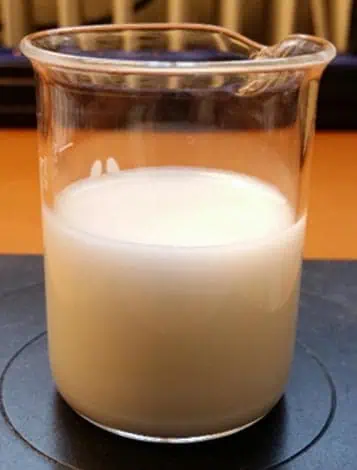 Turbidity is the measure of clarity that applies to all types of liquid. The lower a liquid's turbidity is, the clearer it appears. Conversely, the more turbid it is, the cloudier it appears. Turbidity in water is typically due to the presence of suspended solid particulate, although it can also be from undissolved oils or other substances, such as colloids.

In the ancient world, people had to use their senses to test water quality. They would look, smell, and taste water to make sure it was safe to drink. The Romans, for example, brought fresh water into their cities through aqueducts. They understood the importance of protecting against water-borne diseases and used water clarity as one assessment of the suitability of water for consumption. Through the years, people adopted various methods like filtering or boiling to help improve water quality. Nowadays, water distribution in the western world is a sophisticated industry surrounded by standards - and turbidity measurement is now a primary measurement of water quality at water treatment plants.
In the 1970’s, the US Congress passed legislation which set high standards for drinking water quality throughout the U.S. In the U.S. today, the Environmental Protection Agency (EPA) is responsible for approving water quality standards.
Dirty water, apart from being unpalatable, can contain contaminants which might poison or sicken anyone drinking it. Therefore, before it can be distributed, water must be filtered to a very high standard. Along with chlorination and other processes, turbidity measurement helps control the treatment processes that ensure distributed water is clean and safe to drink.
Turbidity in water is caused by a variety of factors, both natural and man-made. Particulate found in water can be any combination of silt, dirt, bacteria, or chemicals. For instance, agriculture is a common cause of increased turbidity in streams, rivers, and lakes. When farmers irrigate their fields, runoff causes cloudy water to enter water courses. Food processing plants, major construction projects, and mining can cause similar issues.
During rainy seasons, runoff into streams and rivers increases turbidity levels as it carries a lot of dust and dirt with it. When it's raining, water treatment plants have to deal with higher levels of undissolved solids in the raw water coming into their plants. Left unchecked, filters can be overwhelmed and pipes can become clogged - to avoid this, turbidity measurement throughout the treatment process is critical to keeping the plant running and water standards high.
Turbidity levels are also important to the environment. When water sources contain high levels of solids, fish and water plants suffer. Cloudier water limits light penetration into the water which makes it difficult for native plant species to grow like they normally would. This can then affect the entire food chain.
In general, the higher the turbidity of a water source, the higher chance there is that it will make people sick. Measuring turbidity is a critical function in producing clean water.
The most common unit of turbidity measurement is the Nephelometric Turbidity Unit (NTU) and is used to describe the intensity of light scattered off of particulate suspended in water. NTUs are most often associated with the clarity rating of drinking water. The World Health Organization (WHO) states that drinking water should never be above 5.0 NTU.
However, light scatter magnitude is dependent upon particulate size and wavelength of light. However. because there are several variations on this measurement technique, there are several other units quoted in literature that are synonymous with NTU. Those units are all related to each other:
- NTU stands for "Nephelometric Turbidity Unit" and signifies that the instrument is measuring scattered light from the sample at a 90-degree angle from incident broadband (400 – 600nm) white light in accordance with USEPA Method 180.1 (USA).
- FNU stands for "Formazin Nephelometric Units" and also signifies that the instrument is measuring scattered light from the sample at a 90-degree angle from incident NIR (860nm) light in accordance with the European standard ISO 7027.
- FTU stands for "Formazin Turbidity Units" and is the generic term that does not specify how the instrument measures the sample.
The good news is you don’t have to remember them all, because:
1 NTU = 1 FNU = 1 FTU = 1 ppm formazin
However, because formazin is considered carcinogenic (because it is produced using hydrazine sulfate), other standard turbidity standard solutions, notably polymer bead standards, have been created as a safer alternative. In order to differentiate measurements where these alternate solutions are used, additional measurement units have been described by replacing the “F” for Formazin with a “P” for Polymer.
- PNU “Polymer Nephlometric Unit”
- PTU “Polymer Turbidity Unit”
Polymer standards are supplied with stated NTU values, but it should be noted these values are established by comparing against standard formazin solutions, i.e. they are a secondary standard and not a primary standard.
Turbidity is the measurement of light intensity after the interaction of incident (collimated) light with suspended solids and colloidal materials in a liquid sample. This interaction results in light rays being scattered and absorbed rather than transmitted straight through the sample.
As light passes through a sample containing particulate, the particles absorb that light, then re-radiate it in all directions. Particle shape, size, color, and refractive index determine the spatial distribution of the scattered light by the particle. Particles smaller than the wavelength of light (e.g. bacteria) scatter light in equal intensities in all directions, while particles larger than the wavelength of light result in greater forward scattering.
Small particles measuring less than 1/10th of the light’s wavelength scatter light symmetrically like this:

Medium-sized particles measuring roughly 1/4th of the light’s wavelength scatter light in a more forward direction:

Larger particles, with diameters greater than the light’s wavelength, produce scattering that is extremely concentrated in a forward direction:

When turbidity is measured at right angles to the incident light beam (as in the 90° side scatter technique), particle shape and size differences are minimized, providing sensitive measurement of light scatter by all particles in the sample. Both USEPA Method 180.1 the International Standard ISO7027:1999(E) and the defines the measurement of turbidity by NIR light measurement at 90°.
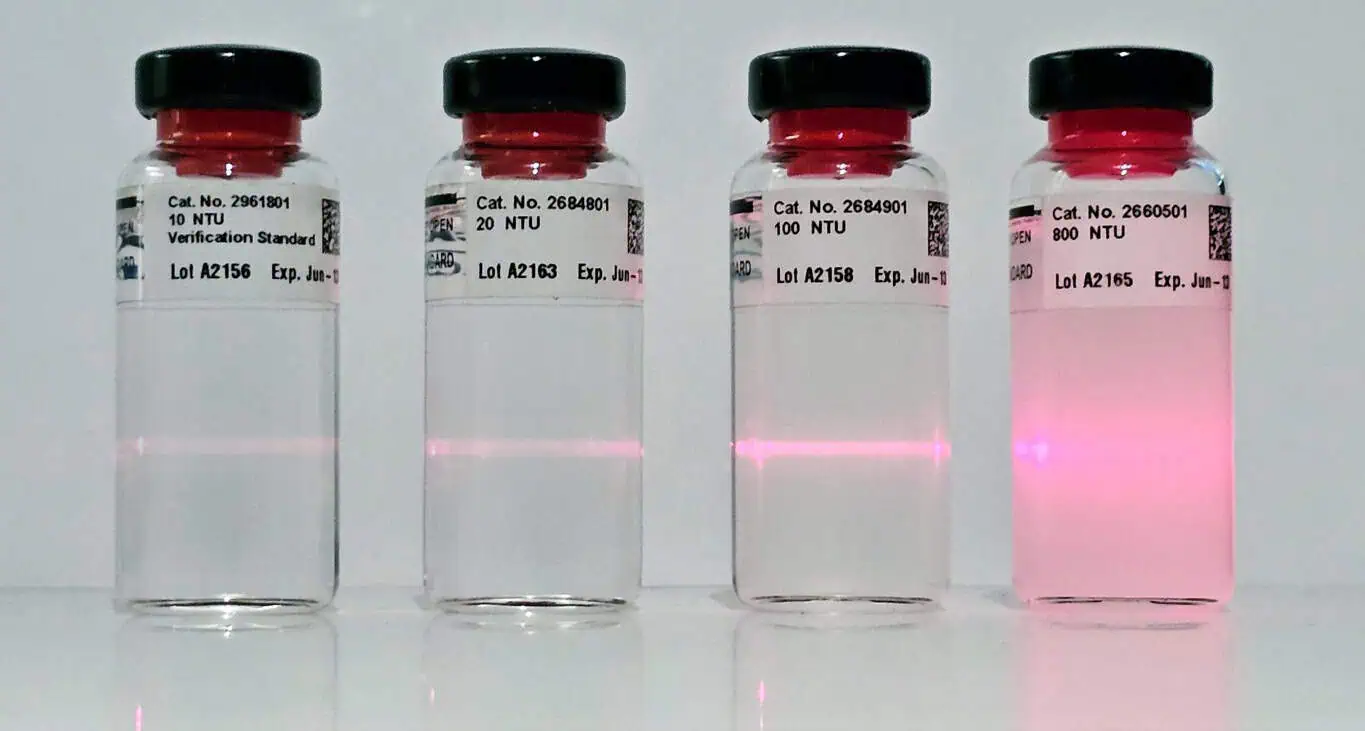
The Exner EXpure low level turbidity sensor measures scattered light exclusively at 90°. The Exner EXspect and EXplore turbidity sensors, dependent upon configuration can measure by attenuation or backscatter. The inherent flexibility of the Kemtrak TC007 turbidimeter allows its measurement components to be configured for 90° side scatter, attenuation and backscatter modes dependent upon the type and turbidity range of the sample being monitored.
This detection method measures the attenuation of the incident light by a detector positioned directly in-line with the incident light beam. The greater the turbidity level in the measurement cell, the greater the attenuation of the light passing through it and the lower the signal the turbidimeter measurement circuit receives.
- Results correlate well to the concentration of suspended solids.
- Can be zeroed between runs to compensate for optical window fouling.
- Large concentration range determined by the optical path length.


Backscattered light is measured using a backscatter probe and allows for the accurate measurement of suspended solids from dilute to extremely high concentration solutions. Incident light is passed into the sample through a single window. Then, particles within the sample scatter back some of the incident light. The more particles there are, the greater the magnitude of the scattered light which returns back through the window.
- Features good sensitivity from 10 FTU to extremely high concentrations.
- Backscatter probe simplifies inline installation.
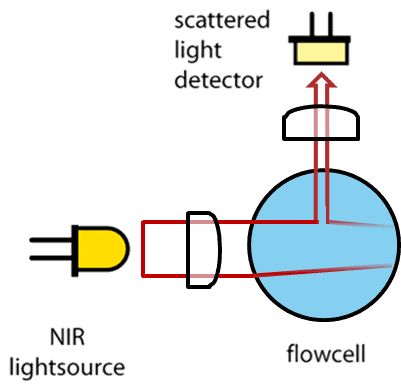 Side scatter is ideal for low turbidity levels, such as drinking water, finished product water, or other clear liquids. It is especially sensitive to fine particles with low mass or low opacity, providing excellent resolution for slight changes in particulate content.
It is not suitable for higher levels of turbidity or where material from the stream can stick to the optical windows and cause the instrument to drift over time (for this, ratio detection is recommended).

Ratio detection is ideal for low level turbidity measurements, particularly where optical window fouling or variable absorption of NIR light may occur. Both transmitted light and scattered light is measured and mathematically combined using a ratio algorithm to calculate the turbidity of the sample. When combined in this way, absorbance of the incident light within the cell and/or any loss due to window fouling (assumed uniform on all windows) will appear in both the numerator and denominator of the ratio algorithm and cancel out, leaving only the turbidity signal.
- Good sensitivity at very low turbidity down to 0.01NTU/FNU.
- Complies with ISO7027:1999(E) using scattered light at 90°.
- Compensation for sample color.
- Compensation for optical window fouling.
Ratio mode has the added advantage that the direct light beam can be monitored and used as a signal quality parameter to indicate the degree of optical window fouling present. Once the signal quality goes below a set value (i.e. 10%), the requirement for cleaning can be signaled.
Have more questions? Take a quick moment to get in touch with our expert sales engineers and technologists and we'll guide you to a solution.
Want help breaking down solutions for your measurement needs?
Please call us at (925) 461-5059 or fill out this form to get in touch with us.
SOUTH FORK INSTRUMENTS
3845 Buffalo Road
Auburn, CA 95602
Tel: (+1) 925-461-5059