
Dairy Industry Phase Monitoring Using Turbidity
Dairies have long been pioneers in the use of turbidity measurement, driven by goals such as quality assurance, process optimization, cost reduction, and resource conservation. For applications with medium to high turbidity—such as milk, cream, and whey—backscatter turbidity measurement is a proven, economical, and reliable method.
To minimize the influence of product color, near-infrared (NIR) light sources are typically used. In backscatter measurement, light projected into the medium is reflected directly back (180°) toward the detector. This design is ideal for high turbidity applications where traditional transmission methods fail, since in those cases too little light passes through the medium to be measured accurately. Transmission measurement, by contrast, remains the preferred method for low to medium turbidity applications.
RISING DEMANDS ON PLANT ENGINEERING
In the past, phase separation—such as milk-to-water transitions—was determined using sight glasses, time-controlled processes, or conductivity measurements. Today, dairies increasingly turn to optical turbidity measurement because it reduces cleaning media, water consumption, and downtime, while ensuring consistent quality.
- Sight glasses provide only subjective estimates, varying from operator to operator.
- Time-controlled switching is imprecise, forcing operators to rely on conservative safety margins, which results in product loss and increased wastewater.
- Conductivity measurement requires compensation for temperature effects and is often unreliable at low product concentrations.
Turbidity measurement avoids these limitations, enabling real-time, objective determination of phase transitions and cleaning endpoints.
APPLICATIONS IN THE DAIRY INDUSTRY
Backscatter sensors are particularly suited to medium-to-high turbidity measurements found in dairy processing, including cream, whey, and yogurt production. Key applications include:
- Separator control (inlet/outlet monitoring)
- Cleaning validation during tank and pipe flushing
- Detection of filter breakthrough
- Phase separation monitoring
- Concentration measurement

REQUIREMENTS FOR MODERN TURBIDITY SENSORS
To remain competitive, dairies must continually reduce waste, improve yields, and lower operating costs—objectives that depend heavily on accurate and reliable turbidity measurement. Modern sensors are designed with these needs in mind. They provide high accuracy and repeatability, particularly valuable in cleaning cycle monitoring where only properly cleaned streams should be recycled. Advanced designs minimize the influence of interfering factors such as entrained air bubbles or sensor fouling, ensuring stable measurement over time.
Equally important is hygienic construction. Turbidity sensors used in dairy applications must feature sanitary designs with no dead space, finely polished surfaces, and materials safe for food contact while being resilient to aggressive cleaning agents and procedures. Since dairy environments are wet and subject to harsh washdowns, sensors must also be mechanically robust and capable of withstanding demanding operating conditions.
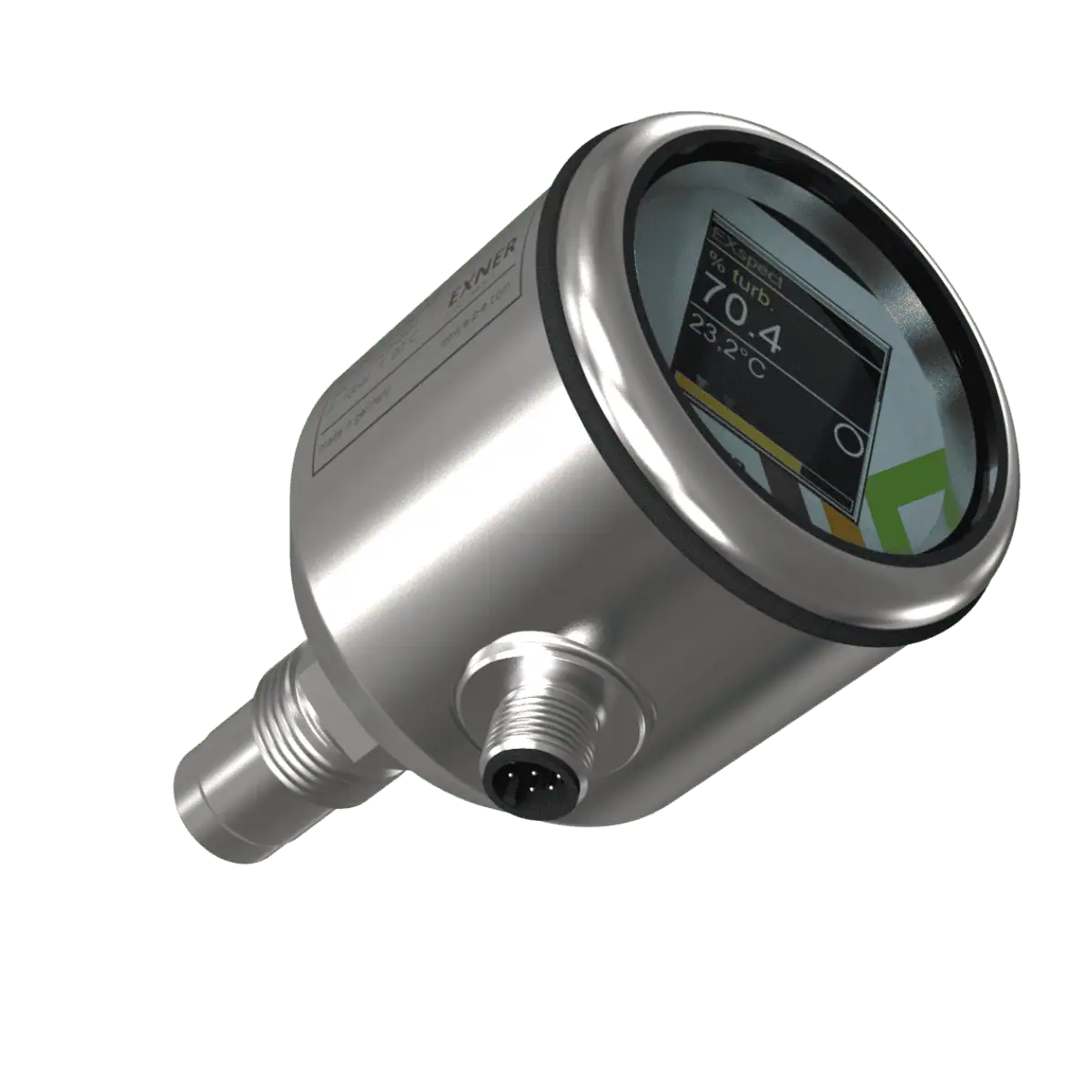
From the user’s perspective, ease of installation and operation plays a critical role. Sensors should be simple to connect and configure in the field, and they must offer reliable options for testing, calibration, and validation using traceable standards. Together, these features ensure that turbidity measurement technology not only meets the strict technical requirements of dairy processes but also delivers practical benefits in day-to-day operation.
EXNER NIR BACKSCATTER SENSORS – INNOVATIVE OPTICAL DESIGN
- Exner has developed a next-generation turbidity sensor that incorporates a patented ball lens for superior optical performance:
- Direct interface measurement at the flowing medium eliminates errors from absorption and reflection.
- Self-cleaning sapphire ball lens prevents deposits, resists fouling, and reduces turbulence.
- Bubble resistance – unlike flat lenses, the curved design prevents air bubbles from clinging to the surface.
- Continuous reliability – lens sits in the product stream, ensuring consistent cleaning during operation.
The sensors use long-lasting NIR LEDs for color-neutral measurement and feature intuitive touchscreen operation. Validation and calibration are quick and reliable using NIST-traceable reference standards.
COST SAVINGS, RESOURCE CONSERVATION, AND YIELD IMPROVEMENTS
By implementing modern turbidity measurement technology, dairies achieve:
- Reduced wastewater costs through lower discharge loads
- Lower freshwater consumption due to optimized cleaning cycles
- Reduced cleaning agent usage without compromising hygiene
- Decreased plant downtime and higher operational efficiency
- Increased product yield with minimized losses at phase changeovers
Advanced NIR backscatter turbidity sensors deliver reliable, economical, and repeatable measurement for dairies and food processors. The result is a combination of improved product quality, optimized processes, and tangible cost savings—while conserving valuable resources.

SOUTH FORK INSTRUMENTS
3845 Buffalo Road
Auburn, CA 95602
Tel: (+1) 925-461-5059